EV charging
Do you need a switchboard upgrade before an EV charger?
It is the single biggest reason two EV charger quotes for the same house come back hundreds of dollars apart. One included the board work, the other left it to be discovered on the day.
A charger is a large, continuous load — often the largest single thing in the house, running for hours at a time. That is a different demand to a kettle, and it is why the board matters more here than for most jobs.
What we are actually looking at
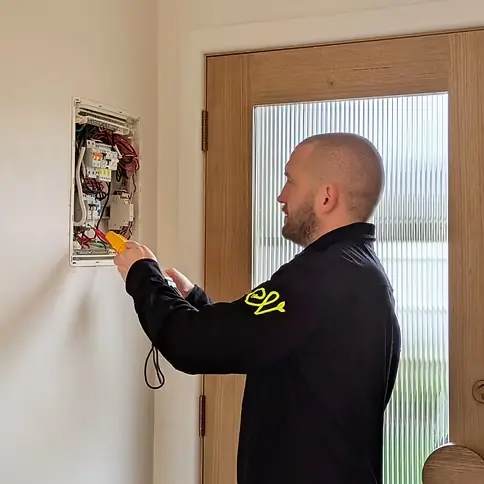
When we ask for a photo of your switchboard before quoting, these are the things we are checking for.
- Spare ways. A charger needs its own dedicated circuit. If the board is full, something has to give — sometimes a sub-board, sometimes a full replacement.
- Ceramic fuses or old-style breakers. If the board still has rewireable fuses, it predates modern safety requirements and it is being replaced as part of the job.
- RCD protection. The charger circuit needs the correct type of RCD. Plenty of boards have none at all on some circuits.
- Main switch and supply capacity. This is the one people do not expect. It is not about the board itself but about what the street can give you, and it decides whether you get a full-speed charger or a throttled one.
The load-management alternative
Here is the part that saves people money, and it is why we ask before assuming. A charger with dynamic load management watches the whole house and backs its own draw off when everything else is running. It means a supply that could not handle a charger at full tilt plus an oven plus an air conditioner can often handle all three, because the charger gives way.
In a good number of Melbourne homes that turns a supply upgrade into a setting. It is not free — it needs the right charger and, usually, a current transformer on the main supply — but it is a lot cheaper than a new service.
Charging a bit slower overnight costs you nothing. You are asleep.
So do you need one?
Often not. A board with spare capacity, modern breakers and working RCDs takes a charger circuit without drama, and that is the majority of jobs we do.
Where the answer is yes, it is usually a board that was due anyway — ceramic fuses, no RCDs, or so full that the next circuit of any kind was going to force the issue. In that case the charger is not causing the cost, it is revealing it.
How to get a price that holds
Send a photo of the open switchboard, a photo of the meter, and a note about where you want the charger. That is enough for us to quote the whole job — charger, circuit, board work if any — as one number, rather than an hourly rate that grows once the wall is open.
More on how we do the install on the EV charger installation page, and on the board itself under switchboard upgrades.